Risk Adjusted Returns: The true measure of success in Stocks and in Mutual funds
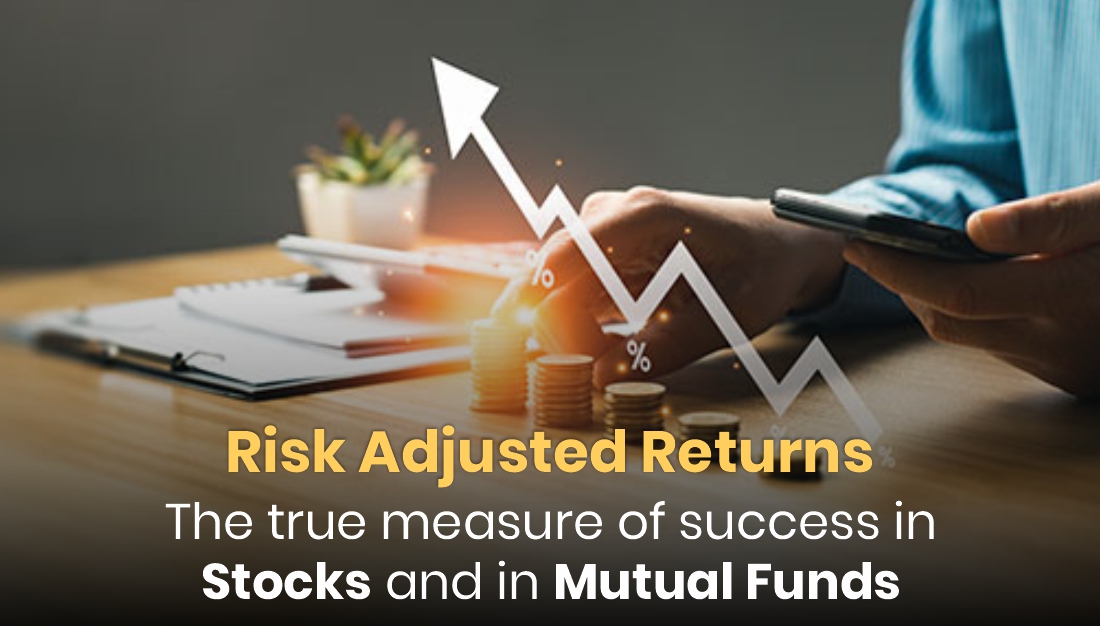
Risk Adjusted Returns: The true measure of success in Stocks and in Mutual funds
Most investors are interested in returns when assessing the investments. But returns in themselves do not give the entire picture of performance. Risk-adjusted returns are actually the true measure of successful investment since they take into account the amount of risk taken in order to get the returns. The idea plays a crucial role in creating a consistent and effective investment portfolio.
Risk-adjusted returns will enable the investor to make comparisons of various investments at an even footing. An example of this could be that an investment that provides moderate returns and is not volatile could be more preferable than one that provides high returns and is highly volatile. This view changes the emphasis on the highest returns to the maximization of the balance between risk and reward.
Volatility can be linked to risk in stock investing. Stocks with a high price variability have the potential of giving high returns, however, their variability is more uncertain. Investors that do not consider this risk can lose a lot when the market is down.
Mutual funds offer a better-organized means of assessing risk-adjusted performance using a number of measures. The Sharpe Ratio is one of the most popular ratios, and it determines the amount of return per unit of risk. When the Sharpe Ratio is high, it means that the investment is providing good returns in comparison to its risk.
Another essential indicator that pays special attention to downside risk is the Sortino Ratio. The Sharpe Ratio focuses on the total volatility whereas the Sortino Ratio focuses on a downward movement in the price, which is why the latter is especially helpful among risk-averse investors.
Other important indicators in the analysis of mutual funds are alpha and beta. Alpha is used to identify the additional yield that the fund produces relative to its benchmark and beta is used to determine how sensitive the fund is to the market movements. A balanced fund will have good alpha and moderate beta which represent good performance at a moderate risk.
Diversification is essential in enhancing the risk-adjusted returns. Through diversification, investors are able to lower the volatility of their entire portfolio by pooling stocks and mutual funds in various sectors and asset classes and still achieve growth potential.
Long-term investment also increases the risk-adjusted performance. In the long term, the market ups and downs are likely to even out, and investments will become more predictable. This underscores the need to be patient and disciplined when investing.
Among the greatest errors that investors commit is risk ignoring. Investigating volatility may result in poor investment outcomes because one may pursue high returns without taking volatility into account. On the same note, comparing investments, only on the basis of returns without factoring in the risk can lead to misleading results.
A better strategy is to consider investments based on a blend of a return and risk measure. This will help investors make better decisions and create a portfolio that can fit their financial objectives and risk-taking ability.
Finally, risk-adjusted returns are more effective and detailed in assessing investment performance. With the risk and the return in mind, investors can enjoy steady growth and develop a strong portfolio, which is not affected by market fluctuations.
risk adjusted returns IndiaSharpe ratio mutual fundssmart investing strategieslong term investment stabilitymutual fund risk analysisinvestment risk vs return